New Critical Essay
BEYOND WILDLIFE:
JEREMIAH D. WELSH AND THE ETHICS OF ATTENTION
by
Prof. Nezar Abdulhafith, Professor of Visual Arts and Aesthetics,
Saudi Arabia (August 2026)


Prof. Nezar Abdulhafith is a Professor of Visual Arts and Aesthetics at Taibah University in Saudi Arabia, with more than two decades of experience in higher education, artistic research, cultural strategy, and institutional leadership. His academic and professional interests focus on visual culture, artistic heritage, cultural identity, and the relationship between art, place, and human experience.
He previously served as Cultural Attaché at the Embassy of the Kingdom of Saudi Arabia in Morocco, where he represented Saudi cultural and educational interests, developed international academic and cultural partnerships, and worked with universities, governmental institutions, and cultural organizations. His work combines academic inquiry with a deep commitment to the preservation, interpretation, and appreciation of cultural heritage and visual expression.
Through his writing and critical reflections, he explores how art can preserve memory, expand perception, and create meaningful connections between individuals, cultures, and generations.
" There are moments in one's intellectual life when an encounter with an artist quietly evolves into an encounter with an idea.
Such encounters are uncommon. They rarely occur during a gallery visit or through the brief admiration of a single work. More often, they unfold gradually, through sustained observation, thoughtful correspondence, and the slow realization that what initially appeared to be an appreciation of artistic skill has become something far more significant—a reconsideration of how we understand art itself.
My encounter with the work of the American sculptor Jeremiah D. Welsh developed in precisely this way.
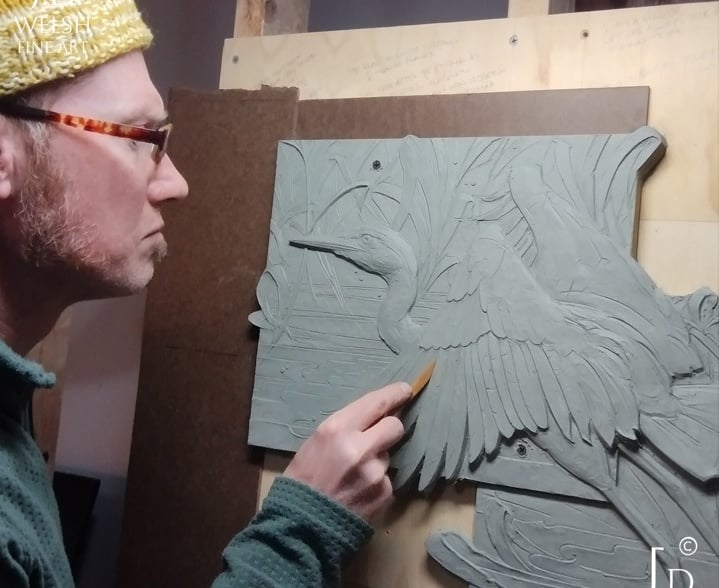
At first, I believed I was engaging with the work of an exceptional wildlife sculptor. His relief sculptures displayed an extraordinary command of form, composition, and anatomical precision. The sensitivity with which he rendered birds, wetlands, flowers, and the quiet rhythms of the natural world immediately revealed decades of disciplined craftsmanship. Like many viewers, I was first captivated by the remarkable fidelity of his observation.
Yet as our correspondence continued, I gradually realized that my initial understanding had been incomplete.
Wildlife is not Welsh's subject.
It is his vocabulary.
His true subject is the human capacity to see."
** Introduction/Excerpt from the 19-page Critical Essay -
Please contact the artist for the complete PDF manuscript


** above and below are the two works specifically discussed in the critical essay
Contact Jeremiah
Inquiries about his sculptures, paintings, exhibitions, and/or about purchasing or commissioning work are welcome.